Determinism over intelligence
Why stella runs one deterministic thread instead of a swarm of agents, what research on multi-agent failures found, and what that means for how it works.
Most agent tools use a swarm: a navigator agent, a coder agent, a reviewer agent, a tester agent, and a coordinator managing all of them. stella does the opposite. It runs one deterministic, single-threaded loop. The research behind it is in this note.
What the research found
The first large study of multi-agent LLM failures, the MAST taxonomy (Cemri et al., UC Berkeley, NeurIPS 2025), found three common ways swarms of agents fail across tools like AutoGen, MetaGPT, and ChatDev:
- Agents disagree. They lose track of the task state and what other agents already did. This leads to actions that contradict each other, work that gets redone, and errors that spread through the coordinator.
- No one can check the work. There's no single thread of execution to replay or check. Finding out which agent went wrong means digging through message logs one by one.
- Information gets lost. Every time one agent hands off to another, it has to summarize, and every summary drops something. The first agent's full understanding reaches the last agent as a vague instruction.
Cost matters too. Kapoor et al. (Princeton, TMLR 2025) show agent systems need to be judged on cost, not just accuracy. Swarms tend to cost more per task, usually without much to show for it.
Meanwhile, two of the strongest systems on the SWE-bench benchmark, Agentless (Xia et al., FSE 2025) and SWE-agent, use a single agent on purpose. A well-designed find → fix → check pipeline beats a complicated multi-agent setup.
How stella avoids this
- One loop. Plan, run tool calls in parallel, look at the results, trim down anything noisy, repeat. There's no coordinator to fall out of sync, no peer to disagree with, and no handoff to lose information in. The swarm failure modes above aren't reduced here. They simply can't happen.
- One transcript. Every decision is a step in one ordered event stream. You can replay it and check it, and it feeds the local telemetry records step by step.
- A pure decision core. The engine does no reading or writing on its own. Its logic is plain, synchronous functions over data it owns. That's what makes it testable, and what makes its behavior reproducible at all.
When parallel work pays off, stella still avoids a shared coordinator or shared state. Fleets run several independent single-thread engines over one shared project, and the only coordination between them is a shared list of file claims (with a dedicated git worktree per task if you turn that on). You get parallel work with no swarm coordination and no messages between agents to lose information.
The coordination is a lock table, not a conversation. If two workers claim overlapping files, they don't negotiate. The second one fails immediately, by name, before it even starts:
[[tasks]]
id = "a"
title = "Rename the error type"
prompt = "Rename StoreError to StoreFailure across the crate"
claims = ["src/store/error.rs"]

[[tasks]]
id = "b"
title = "Add a variant"
prompt = "Add a StoreError::Corrupt variant carrying the failing pragma"
claims = ["src/store/error.rs"] # same path — one of these two will not runstella fleet --plan parallel.toml --max-concurrency 2That's the whole coordination protocol. There's no message for two agents to misread, and no summary between them to lose information. The third MAST failure class, information loss, has nowhere to happen.
The bigger idea
Preferring determinism over intelligence doesn't mean stella avoids using models. The whole point of stella is to put strong models to work. It's a statement about where to spend them:
- Verification comes from a wrapper plugin you turn on
with
--pipeline <variant>. It works with a flip: a test that fails before your change and passes after it. The plugin runs that check and reports what it found. stella checks that report against the rule the plugin set up when it was installed, and never re-runs the check itself. No model is ever asked to judge unclear evidence. If a report doesn't meet the rule, the result is "not proven". - The one model call a plugin like this spends on evidence writes the failing test. It never judges the result. The test's own fail-then-pass flip does that, just by running.
- Goal mode works differently, with its own verifier. After every round, without exception, a separate model checks the transcript against the goal. This isn't a fallback for unclear evidence. It runs every round no matter what, and if the check itself fails to run, it says so instead of making up a verdict.
- Routing, budgets, trimming context, retries, and pulling in memory are all handled by plain, boring, checkable code. The model's attention goes to the two things only a model can do: writing the change, and judging what a mechanism can't measure.
This adds up. Deterministic mechanisms cost nothing to run, never hit a rate limit, never make things up, and give you the same answer twice. That's exactly what you want from the part of an agent that decides whether to trust it.
Interactive mode shows this split instead of just describing it. Open a task and you see its contract: what "done" means, which checks are computed and which need a model, and what the work actually cost. Below that, the plan it was given sits next to what actually happened. If they differ, that's recorded, not glossed over.
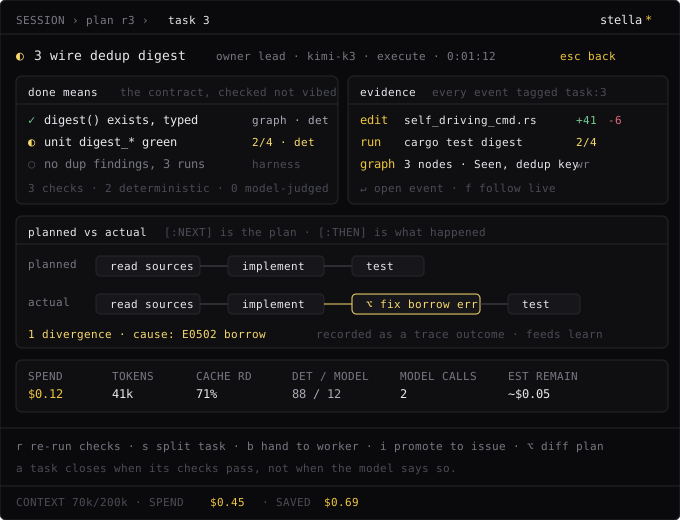
Because this split is built into the system, not just a way of talking
about it, it's also machine-readable. A raw run reports what it did, and
nothing about proof: its status, what it spent, and the files it touched:
stella run --output-format json \
  "make the loop detector count identical no-op calls as progress-free" \
  | jq '{status, cost_usd, files_touched}'
Turn on a verification plugin, and the same output now carries its verdict, so a CI gate can require evidence instead of a claim:
stella run --output-format json --pipeline my-verifier --test-command "make test" "$TASK" \
  | jq -e '.status == "completed"' >/dev/null \
  || { echo "nothing proved this run — holding it for review" >&2; exit 1; }
The raw loop has no check to arm, so --test-command is refused there. See
stella run.
Read the full papers: the deterministic engine and the seven defensible properties.
Engineering Principles
The design rules behind stella — determinism over intelligence, evidence over opinion, an engine with no I/O of its own, and spend limits enforced at safe points.
No silent overwrites
stella refuses to write over a change it never saw, with no lock, no background service, and no need to know who else is working on the file. How this works, what it doesn't promise, and what happens after a crash.